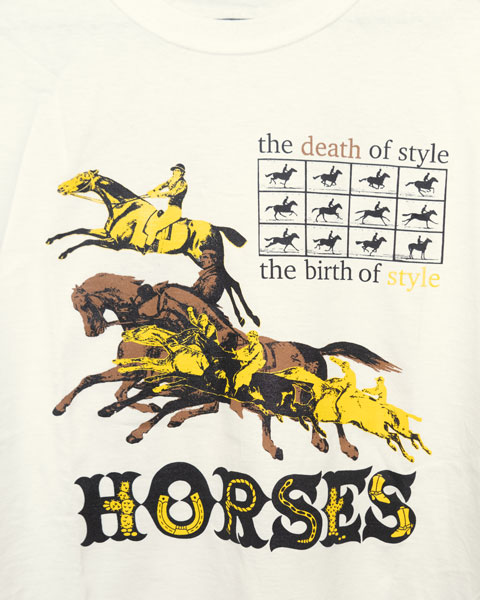

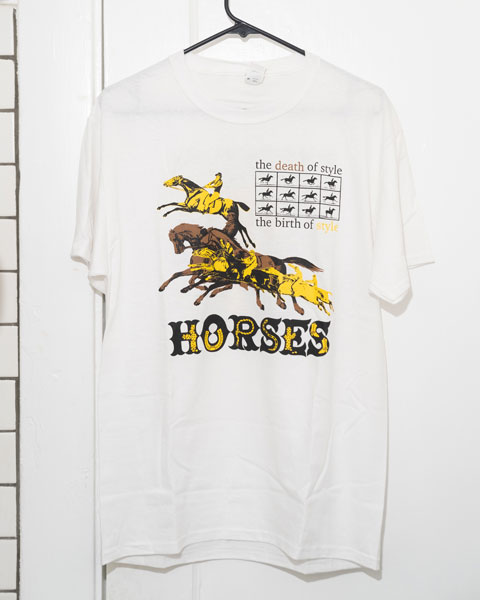
On June 15th 1878, Eadward Muybridge took twelve photos of a horse named Abe Edgington in just under one second. He then developed the exposed plates in front of an audience of assembled pressmen to ensure that there could be no doubt as to the veracity of the images he had recorded. With this small moment in time, Muybridge al- tered the course of human history. Years of experimentation and coordination had gone into this moment, and finally, it was possible for human eyes to see the heretofore imperceptible truth of what a camera saw. The results were surprising, if not altogether unexpected. Contrary to popular belief, a horse’s gallop was not composed of a series of graceful flying leaps through the air, but rather by a convulsive gathering and release of its legs beneath its body in a mechanical sequence.
This new reality contradicted many celebrated depictions of horses in seemingly mid gallop that had been produced in the years before. In fact, the “flying gallop” as it is called, constituted an identifiable style in painting and drawing of the early 19th century; and there is evidence of the flying gallop stretching back into antiquity. Two ex- emplary painters that practiced this style were Théodore Gericault and George Stubbs. Gericault is perhaps best known for his painting Raft of the Medusa, a piece that combined elements of history painting with the burgeoning Romantic movement in France. But Gericault’s lifelong passion was for horses and he nurtured that passion by painting them obsessively throughout his life including in an 1821 painting he produced of the Epsom Derby. Here, four horses are seen in close formation, traversing the canvas from right to left, against a cloud gray sky that is just breaking to allow the sun to shine through and illuminate the horses and their riders. All of the horses are frozen in a flying gallop, as if at the apex of their race and in the exact position that Muybridge would remove from the realm of physical possibility fifty years later. George Stubbs– another painter fond of horses, oftentimes depicted them in a similar flying gallop that communicated the dynamism and action of the moment. Stubbs was both self-trained as a painter and acknowledged as a master of painting animals, an honorific often attributed to his monomaniacal study of anatomy, in particular that of horses. It is ironic then, that such a master of anatomy was unable to comprehend the proper mechanism of horse locomotion. But perhaps Stubbs and Gericault were more concerned with capturing the feeling of a horse in motion than with the staid truth of the matter.
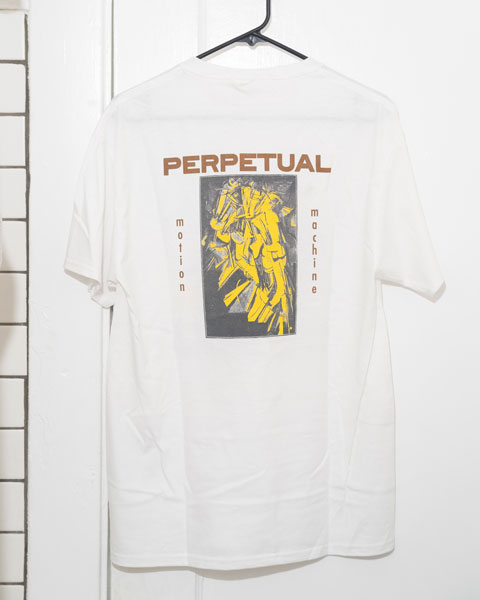
It is possible that by the time Muybridge’s sequence of photos was published the flying gallop style was on its way out. But the story does not end there. If Muybridge’s horse shut the door on Stubbs’ and Gericault’s horses, it also opened a window onto new vistas of visual repre- sentation. The invention and proliferation of photogra- phy provoked a crisis of faith within the other fine arts, particularly painting. The Impressionists, the Fauvres, the Cubists, and countless other movements owe much to the newfound freedom of representation they enjoyed because of photography’s ascendant role in visual documentation. Yet even as the Cubists were breaking open the rules of geometric perspective, Marcel Duchamp was looking to the past in order to break the rules of the Cubist present. His 1912 painting Nude Descending a Staircase No. 2 depicted a human figure at discrete moments in its descent down a staircase. Duchamp’s innovation then, was to depict a subject from multiple moments in time in addition to multiple geometric perspectives in a single static image. Duchamp effectively reiterated the purpose of the “flying gallop”— the depiction of dynamic motion— but his solu- tion was inextricably tied to the revelations of Muybridge’s twelve photos. Thus, the agent of the demise of one form of visual representation engendered the production of a new one.
This process of invention, refutation, and reinvention is the process of history itself. Moreso, our past history molds our present reality, and as Paulo Freire has written “reality is really a process, undergoing constant transformation” (48, emphasis in original). Muybridge’s camera was an inflection point in this process. A moment in time when the path of history diverged and reality was reconstructed to accommodate the new status quo. Horses galloped one way until, suddenly, they galloped another. But even this sentence is misleading. Horses have always galloped the same way. What changed was how we saw them. As our vision changed, one mode of representation was retired, but new methods were created in its place. Thus the machine of history continued to move forward in ever perpetual motion.
Works Cited
- Brookman, Philip. Helios: Eadweard Muybridge in a Time of Change. Steidl Publishers, 2010.
- Edgerton, William F. “Two Notes on the Flying Gallop.” Journal of the American Oriental Society 56, no. 2 (1936): 178-88. https://doi.org/10.2307/594665
- Freire, Paulo. Pedagogy of the Oppressed. Penguin Classics, 2017.
- Jaffe, Irma B., and Gernando Colombardo. “The Flying Gallop: East and West.” The Art Bulletin 65, no. 2 (1983): 183-200. https://doi.org/10.2307/3050317 Scharf, Aaron. “Painting, Photography, and the Image of Movement.” The Burlington Magazine 104, no. 710 (1962): 186-95. http://www.jstor.org/stable/873665